Sports Club Analytics: What to Track and How to Use It
27 November 2026

Sports Club Analytics: What to Track and How to Use It
Sports club analytics, for a team manager or club administrator, means turning the everyday records of a club into decisions: who turns up, who is available, who has paid and where the season is drifting. You do not need a data science degree or a spreadsheet full of formulas. You need the right handful of numbers collected automatically, in the same place you already schedule games and message players. Sidekick is a free sports management app built around that idea: scheduling, team chat, registrations, payments and attendance live in one platform, so the numbers exist without anyone typing them up.
TL;DR
- “Sports club analytics” covers two things: student clubs that study sports data, and the practical numbers a team or club uses to run itself. This guide is about the second.
- Five measures do most of the work: attendance, availability responses, registrations, payments and roster status.
- The value is in the decisions: who to chase, when to schedule, which fees are outstanding, which sessions are losing players.
- Data only helps if it is collected as a by-product of running the team, not as a separate admin job.
- Sidekick covers every feature without subscription fees, paywalls or premium tiers, and charges only a small fee when money moves through it.
Table of Contents
- Two meanings of sports club analytics
- The five measures a club should track
- A worked example: one month in a social team
- From numbers to decisions
- Collecting data without creating extra work
- Privacy: handle player data with care
- What AI adds, and what it doesn’t
- Why a free, all-in-one app suits club analytics
- Put it to work with Sidekick
- Our perspective
- FAQ
- Sources
Two meanings of sports club analytics
Search this phrase and you mostly find university groups. Northeastern’s Sports Analytics Club describes a community for students of all disciplines who learn sports analytics through hackathons, research competitions, independent research and workshops. Notre Dame’s club says its members work with 12 varsity athletic programs on scouting reports and player evaluations. If you are a student who wants to build models, those are the places to start, and most state that you do not need prior experience: the University of Virginia’s group says no particular major or background is required.
This article is for the other reader: the manager of a social team, the coach of a youth side, the volunteer running a club’s registrations. Your “analytics” is not a neural network predicting passing plays. It is knowing, before Saturday, whether you have enough players, and knowing, before the season ends, which fees are still unpaid. That is the same discipline, applied to the questions a club actually faces.
The five measures a club should track
A useful rule: track a number only if you know what you would do differently when it changes. These five pass that test for almost every team and club.
1. Attendance
Attendance at training and games is the most honest signal in a club. It tells you who is committed, which sessions lose people and whether your schedule suits the group. Look at it three ways:
- Per player: a player who has slipped from most sessions to few is worth a friendly message long before they quit.
- Per session type: if Thursday training draws far fewer players than Tuesday, the problem is the slot, not the players.
- Over the season: a gradual decline in the middle of the season is normal in many sports, but a sharp drop after a run of losses or a schedule change is a signal to act on.
Our guide to attendance analytics for sports teams and clubs goes deeper on reading these patterns. The important point here is that the figures only exist if attendance is recorded as part of normal team life. When players respond to events and the coach marks who showed up in the same app, the history builds itself.
2. Availability responses
Availability is attendance before it happens. The share of players who answer within a day, and how many say yes, predicts whether you can field a side. Teams that wait until the morning of a match to find out are forced into panicked group messages and forfeits.
Track two things: how quickly the squad responds, and which individuals routinely leave the question unanswered. The second group is usually small, and a direct nudge fixes most of it. Our page on player availability and the 24 to 48 hour window explains how to read updates as they arrive so you can recruit a substitute in time.
3. Registrations
For a club, registration numbers are the top line. How many players signed up for each team, how many completed their forms, how many are still pending. Two practical checks matter:
- Completion rate: a long gap between “started” and “finished” means your form or payment step is putting people off.
- Team balance: one team oversubscribed and another short tells you where to open a new squad or move players before the season starts.
If you run registration for a club, see how online sports registration works without subscription fees.
4. Payments
Money is where volunteer managers lose the most evenings. The numbers to watch are simple: total owed, total received, and who is outstanding. That covers registration fees, but also the smaller pots that every team has, such as gift funds for birthdays and fines for forgetting the kit.
A live view of who has paid removes the awkward individual chasing. You see the list, you send one reminder to the right people, and the rest of the squad never hears about it.
5. Roster status
A roster is data too: who is registered, who is eligible, who has completed the paperwork. Errors here have real consequences, from fielding an ineligible player to mishandling personal details. Our guide to roster management for clubs covers eligibility checks and the data protection side.
A worked example: one month in a social team
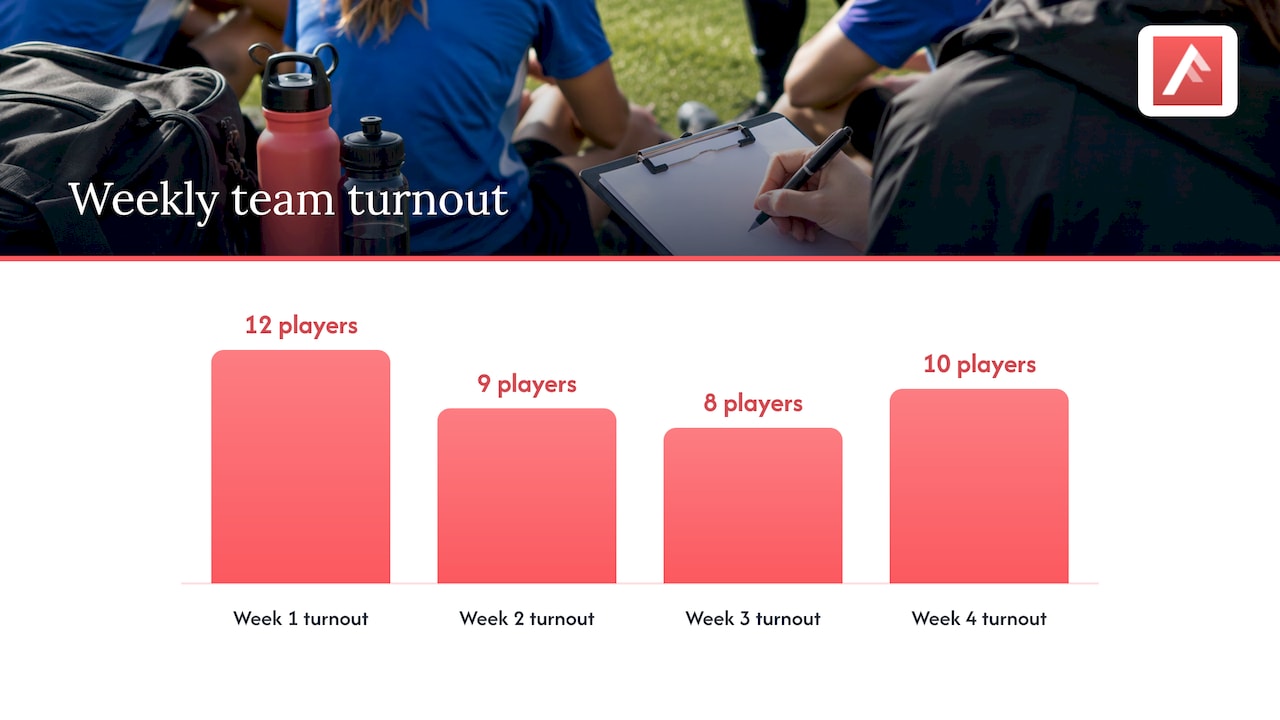
Here is an illustration, with invented numbers, to show how the measures work together. Imagine a social team of 14 players that needs 11 to play.
| Week | Said yes by Wednesday | Turned up | What the manager did |
|---|---|---|---|
| 1 | 12 | 12 | Nothing needed |
| 2 | 10 | 9 | Messaged the four non-responders |
| 3 | 8 | 8 | Asked the bench to confirm earlier |
| 4 | 11 | 10 | Moved kickoff reminder to two days before |
No single week looks alarming. But read together, the manager sees a team that is sliding in the middle of the month and that responds to earlier reminders. Two small changes, an earlier question and a direct message to the quiet players, protect the fixtures. Without recorded responses, the same manager would only remember that week 3 felt stressful.
The same logic applies to money. If six of 14 players have not paid by the second game, you have a collection problem, not a six-person problem, and a single clear reminder with a payment link will do more than six private chats.
From numbers to decisions
Data is useful when it changes what you do. These are the decisions club analytics most often informs.
Scheduling. If attendance is consistently lower on one night or at one venue, move it. Ask the squad, then check whether the new slot improves turnout over the next month.
Communication. Coaches gain from knowing who reads and answers messages. If one player never responds in team chat but always turns up, that is a communication preference, not a commitment problem. If a player answers yes and then does not appear, that is a different conversation.
Selection and development. Coaches who record evaluations during tryouts have a fair basis for selection. Our tryout evaluation forms guide sets out six steps for scoring players consistently, which is analytics in its simplest form: the same criteria, applied to everyone.
Club planning. A club administrator looking across teams can see which squads are full, which are shrinking and where fundraising or kit sales could help. Even student groups that study this field emphasize turning numbers into explanation: Duke’s club says its projects are meant to show the ability to turn findings into useful commentary. A manager does the same thing every time they explain to a committee why a team needs another coach.
Collecting data without creating extra work
The reason most clubs do not use their data is that collecting it feels like a second job. A spreadsheet needs updating, a group chat needs scrolling, and a payment list needs reconciling by hand. Three habits keep it light:
- Record once, where the action happens. Availability, attendance and payment should be captured in the tool you already use to organize the team.
- Review on a rhythm. A five-minute look after each game, and a longer look monthly, is enough.
- Share what matters. Players respond better to a simple message such as “we have eleven confirmed, thanks everyone” than to a spreadsheet.
Other sports apply the same principle. Reporting for golf clubs, for example, works because the booking system itself produces the records; the BallChute guide to tee sheet reporting shows what a club can track once bookings are captured digitally.
Individual performance is a separate layer. If your athletes want to understand movement and injury risk, video-based tools exist, and this overview of AI in sports training explains what they do. For running a team or club, though, the operational numbers above come first.
Privacy: handle player data with care
Attendance, payment and contact records are personal information, and many of your members are minors. Collect only what you use, keep it among the people who need it, and tell members what you hold. Our practical guide to team data privacy lists what clubs and managers should do. Rules differ by country and by state, so check the requirements that apply to your club and, for a formal organization, speak to a lawyer or your governing body.
What AI adds, and what it doesn’t
AI-driven analytics earn their place when they save you reading time: spotting a falling attendance trend, flagging who has not responded, summarizing the financial position of a team. They are not a substitute for knowing your players. Our guide to AI for team management looks at what works in sports teams. Sidekick includes AI-driven analytics among its features, alongside attendance and payment tracking that give coaches and managers insight into attendance and financials.
Why a free, all-in-one app suits club analytics
Grassroots sport runs on volunteers and small budgets. Many tools split their useful features across tiers, so the reporting you need sits behind a subscription. Sidekick takes a different route: every feature is available without subscription fees, paywalls or premium tiers, and unlimited teams can be managed. The only cost is a small fee when money is moved through registrations, gift funds and fines. Parents and players use the app to see information and never pay for access.
That matters for analytics because the data is only as good as the number of people who use the tool. When every player, parent and coach can join at no cost, the attendance, availability and payment records cover the whole squad rather than the few who pay for access.
Put it to work with Sidekick
If you manage a single team, Sidekick for teams brings scheduling, team chat, roster management, attendance tracking and payment collection into one app, with gift funds and fine funds built in. If you run a club, Sidekick for Clubs adds club-level oversight, registration collection, fundraising tools and a marketplace for kit and merchandise.

You can start on the Sidekick home page and build your first team, then let the attendance and payment history accumulate as the season goes on.
Our perspective
Most club analytics advice starts from the assumption that you have a data person. Most clubs have a volunteer with a day job and a group chat that has 400 unread messages.
We built Sidekick on the belief that the best analytics are the ones nobody has to compile. When scheduling, chat, registrations and payments live in one place, attendance and financial insight is simply there, and the manager’s job becomes deciding rather than collecting.
That is also why the platform is free for life. Cost should never be the reason a grassroots team goes without a clear picture of its own season. Managers, coaches, players and parents all get the full platform, and we only take a small fee when money moves.
If you take one thing from this guide, make it this: pick the five measures, record them where the team already talks, and look at them every week.
Mattias
FAQ
What is sports club analytics?
It can mean a student group that studies sports data, or the practical use of team and club records to run a season. For managers and coaches, it means tracking attendance, availability, registrations, payments and roster status, then acting on what the numbers show.
Do I need technical skills to use analytics in my team?
No. The measures that matter most are counts and percentages that a good app records for you. Even the student clubs say beginners are welcome: the University of Wisconsin–Madison club’s president told the university’s statistics department that new members are not expected to know how to build predictive models. For a team manager, reading a simple attendance list is enough.
How often should I review team data?
A quick look after each game and a fuller review once a month works for most teams. Check availability responses a couple of days before each fixture so you have time to find a replacement if you are short.
What does Sidekick cost?
There are no subscription fees, paywalls or premium tiers. Sidekick charges a small fee only when money is processed through registrations, gift funds or fines.
Sources
- Sports Analytics Club, Northeastern University Khoury College
- Sports Analytics Club, University of Notre Dame
- Sports Analytics at the University of Virginia
- Duke Sports Analytics Club
- University of Wisconsin–Madison Statistics: Sports Analytics Club report
- Tee Sheet Reporting: What to Track and How to Use It
- AI in Sports Training: What It Actually Does for Athletes